AI Token Counter Guide: Estimate API Costs Accurately
An AI token counter measures how many tokens your text consumes across different language models, where a token is roughly three-quarters of an English word but varies significantly by language and model. The ToolStand AI Token Counter supports 12 major LLMs from OpenAI, Anthropic, Google, and Meta, normalizing costs per million tokens so you can compare pricing across providers before sending API requests — critical for budgeting at scale.
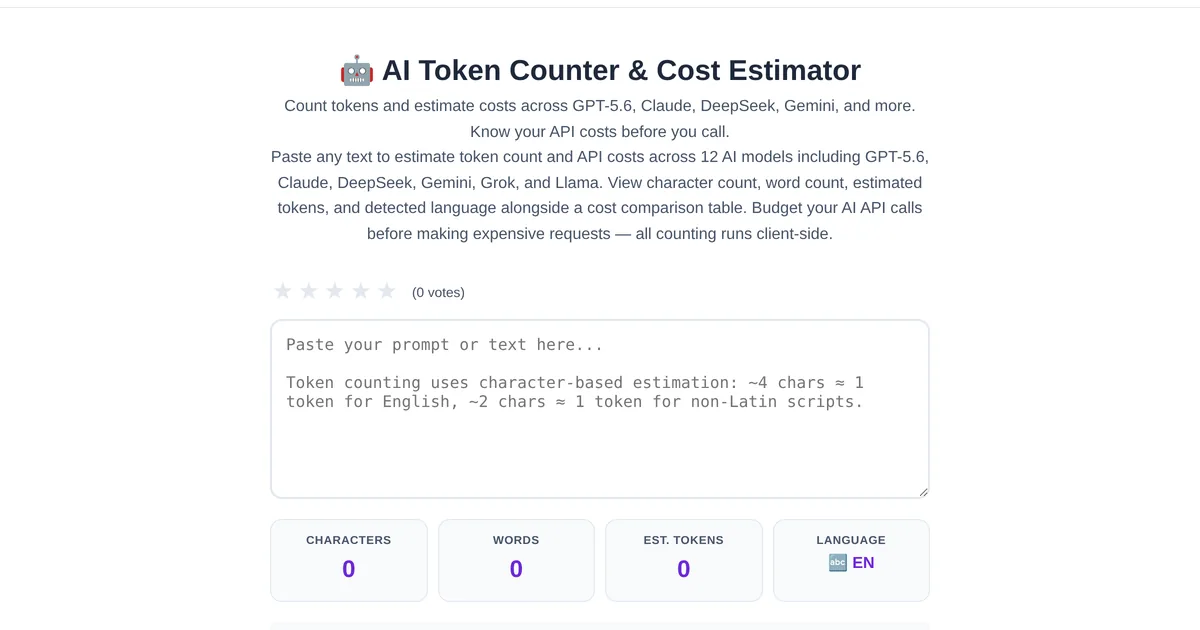
Every AI API call costs money, and every model charges by the token. But what counts as a token? How many tokens are in your prompt? And how do you estimate costs before you hit send? An AI token counter answers all three questions in seconds.
What is a token?
A token is the basic unit of text that AI models process. For English text, a token is roughly three-quarters of a word — meaning 100 tokens is about 75 words. But the exact count depends on the model tokenizer. The ToolStand AI Token Counter and Cost Estimator counts tokens across 12 major models from OpenAI, Anthropic, Google, and Meta.
Estimating API costs
Each model has different pricing for input versus output tokens. GPT-5.6 Terra charges $2.50 per million input tokens and $15 per million output tokens. A 500-token prompt with an expected 1,000-token response costs roughly $0.016. But at scale — 10,000 API calls per day — that is about $160 daily. The counter makes these tradeoffs visible.
Building cost-efficient prompts
The AI Prompt Builder and Optimizer helps you write prompts that are both effective and token-efficient. It structures your prompt with role, context, task, format, and tone controls, eliminating wordy preamble that wastes tokens. A well-structured 200-token prompt often outperforms a rambling 800-token one — and costs 75 percent less per call.
Practical cost scenarios
Customer support: 200-token prompt plus 300-token response times 1,000 interactions per day on Gemini 3.1 Flash-Lite equals about $0.50 per day. Content generation: 1,500-token prompt plus 3,000-token response times 100 articles per day on Claude Sonnet 5 equals about $5 per day. Code review: 5,000-token prompt plus 2,000-token response times 50 reviews per day on GPT-5.6 Terra equals about $2 per day.
Cross-model cost normalization
The same 10,000-token workload costs drastically different amounts across models. Gemini 3.1 Flash-Lite processes it for about $0.0025, GPT-5.6 Terra for $0.025, and Claude Opus 4.8 for $0.05. The ToolStand AI Token Counter normalizes costs per million tokens across a dozen popular models so you can compare pricing side-by-side before sending a single API request. This cross-model view is essential for budget-conscious teams running high-volume inference.
Model lineups and per-token prices in this guide were last verified on July 16, 2026 — always re-check the official provider pages before budgeting: OpenAI API pricing, Anthropic pricing and Google Gemini API pricing.
Non-English token penalty
Tokenizers are optimized for English, meaning non-English languages often consume 2-5x more tokens. The Turkish phrase “Merhaba dünya” consumes about 7 tokens, while “Hello world” uses only 2 on GPT tokenizers. As a rough guide: English 100 words ≈ 130 tokens, Turkish 100 words ≈ 180 tokens, Japanese 100 characters ≈ 150 tokens. If your application serves multilingual users, this penalty directly increases your API costs — the Token Counter highlights it so you can budget accordingly.
Token creep in conversation loops
Multi-turn chat APIs re-send the entire conversation history with every turn. A 10-turn conversation that starts with 500 tokens balloons to over 5,000 tokens by turn 10. The formula: total_tokens = n × (avg_prompt + avg_response) + (n × (n-1) / 2) × avg_increment. This hidden accumulation means a seemingly cheap API call becomes expensive as the conversation grows — the AI Token Counter shows both single-call and accumulated costs.
Frequently asked questions about tokens
How many tokens is 1000 words?
Approximately 1,300 tokens in English, but this varies by model tokenizer. Claude and GPT use different splitting rules, so the same text may produce different token counts on different models.
How do I estimate API costs before building?
Multiply your input token count by the input price-per-million, then add expected output tokens times the output price. The AI Token Counter automates this for all 12 supported models.
What’s the difference between GPT-5.6 Sol and Luna pricing?
GPT-5.6 Luna is 5x cheaper per token than Sol ($1/M input vs $5/M, $6/M output vs $30/M), making it ideal for high-volume tasks like text classification where slight quality loss is negligible compared to the cost savings.
Does chat history count toward token usage?
Yes — the entire conversation history is re-sent each turn, so a 10-turn conversation can cost 5-10x more than a single prompt. Monitor accumulated tokens closely for chat applications.
Why does my Turkish/Japanese prompt cost more than English?
Non-English languages with non-Latin scripts or agglutinative morphology require 2-5x more tokens because tokenizers are optimized for English morphology and character distributions.
Explore the full collection of free tools at toolstand.io. Free, forever. No sign-up. No download. Just tools that work.