How to Convert Numbers to Roman Numerals (And Back)
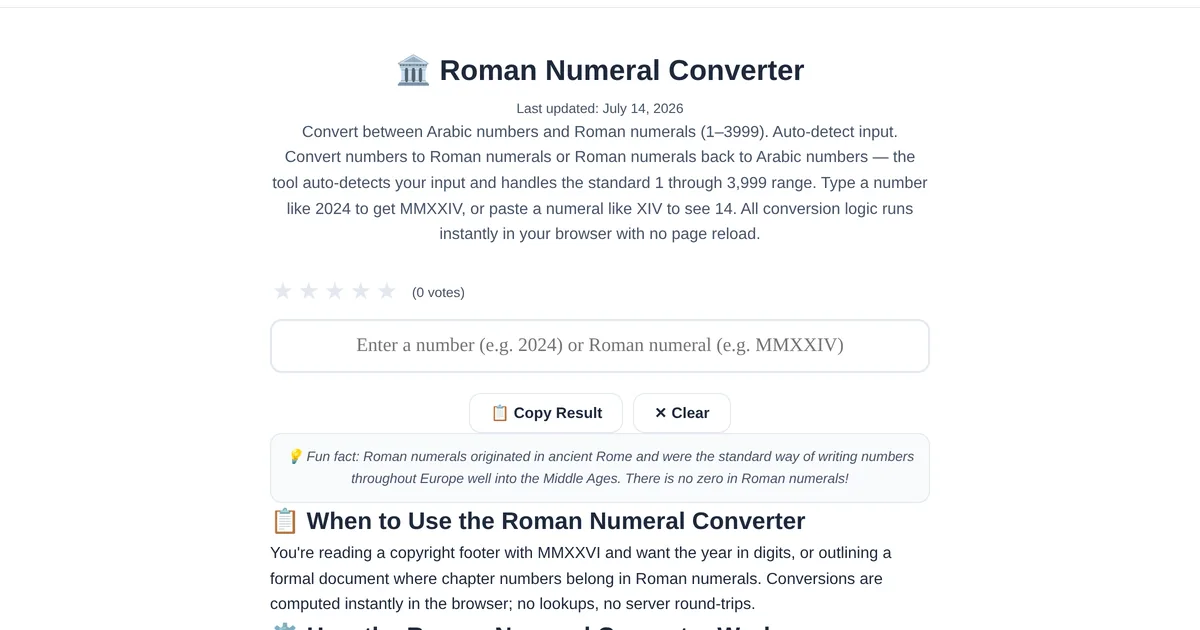
Roman numerals appear everywhere: movie credits (MMXXVI), book chapters, clock faces, Super Bowl logos, and building cornerstones. Converting between Roman numerals and regular numbers is simple once you know the rules — but a free converter makes it instant for numbers above a few thousand.
How Roman numerals work
The Roman numeral system uses seven letters: I (1), V (5), X (10), L (50), C (100), D (500), and M (1000). Numbers are formed by combining these symbols, usually largest to smallest. The key rule: when a smaller symbol appears before a larger one, you subtract it. IV is 4, IX is 9, XL is 40. The ToolStand Roman Numeral Converter handles all these rules automatically.
Common pitfalls
The subtraction rule only applies to specific pairs. You cannot write 99 as IC — it must be XCIX. You also cannot use more than three of the same symbol in a row: 4 is IV, not IIII. The converter catches these errors instantly.
Where Roman numerals still matter
Copyright dates. Movie credits often use Roman numerals. MMXXVI equals 2026. Legal documents. Formal structures use Roman numerals for top-level sections. Clocks and watches. Traditional clock faces use Roman numerals. Generational suffixes. Names like "John Smith III" use Roman numerals.
Going beyond Roman numerals
ToolStand offers converters for other numeral systems too. The Number Base Converter translates between binary, octal, decimal, and hexadecimal in real time. The Scientific Calculator handles trigonometry, logarithms, powers, and roots.
Explore the full collection of free tools at toolstand.io. Free, forever. No sign-up. No download. Just tools that work.