How to Use a Metronome for Better Music Practice
Master rhythm and tempo with a free online metronome. Understand time signatures from 4/4 to 7/8, learn tempo markings from Largo (40-60 BPM) to Presto (168-200 BPM), and practice subdivision exercises that build timing precision. Explore polyrhythms — playing 3 against 2 or 4 against 3 — and how musicians use the metronome to internalize complex rhythmic patterns across genres from classical to jazz to metal.
Every musician has struggled with timing. You learn the notes, memorize the chords, but when you play along with a recording, something feels off. The problem usually is not your fingers — it is your internal clock. A metronome is the most underrated tool in any musician practice kit, and a free online metronome makes it accessible to everyone.
Why rhythm matters more than speed
Most musicians obsess over playing faster. But speed without rhythm sounds sloppy. A metronome forces you to internalize steady time — the foundation every other musical skill builds on. When you practice with a metronome, you are training your brain to subdivide beats automatically, which makes ensemble playing, recording, and improvisation feel natural instead of panicked.
Setting up your practice session
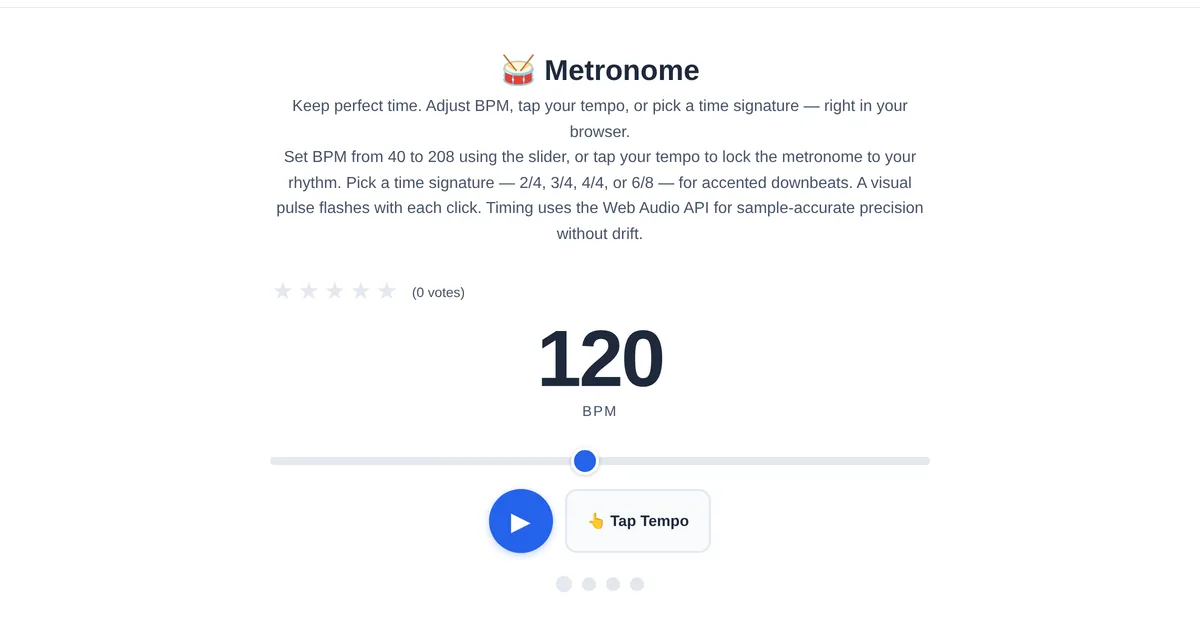
Open the ToolStand Metronome and set your tempo. For beginners, start at 60 BPM — one beat per second. The visual pulse indicator helps if you are in a noisy environment. The tool also lets you emphasize the first beat of each measure, which is crucial for practicing in different time signatures like 3/4 or 6/8.
The half-speed technique. If you are struggling with a passage, cut the tempo in half. Play it perfectly three times at half speed before increasing by 5 BPM. This builds muscle memory that is accurate, not rushed. Most mistakes happen because you are practicing at a tempo your fingers cannot yet handle cleanly.
Advanced metronome exercises
Displaced clicks. Set the metronome to click only on beats 2 and 4 instead of 1 and 3. This forces you to feel where beat 1 is without hearing it — the same skill jazz musicians use to swing. It is uncomfortable at first, but it dramatically improves your internal pulse.
Graduated tempo drills. Start a challenging passage at 40 BPM. Increase by 2 BPM each repetition. By the time you reach your target tempo, the passage feels effortless because your brain absorbed every micro-adjustment along the way.
Pairing with the BPM Tap Tempo tool
Sometimes you need to figure out the tempo of a song you are learning. The BPM Tap Tempo tool lets you tap along to any recording and instantly see the beats per minute. Use it to set your metronome to the exact tempo of reference recordings without guesswork.
Time signatures — a quick reference for musicians
A time signature tells you two things: how many beats per measure (top number) and what note value gets one beat (bottom number). 4/4 (common time): four quarter-note beats per measure — the default in rock, pop, and electronic music. Set your metronome to accent beat 1 for a strong downbeat. 3/4: three quarter-note beats — waltz time. Accent beat 1, lighten beats 2 and 3. 6/8: six eighth notes, grouped as two dotted quarters (ONE-two-three-FOUR-five-six). This is compound time — the metronome should click on the dotted quarter. 5/4 and 7/8: odd meters used in progressive rock and Balkan folk music. Subdivide into 2+3 or 3+2 (for 5/4) or 3+2+2 (for 7/8). The metronome tool lets you set any time signature from 1/4 to 12/8 with custom accent patterns.
Subdivision progression — from whole notes to sixteenth notes
The path to rhythmic mastery is systematic subdivision. Start at a slow tempo (60 BPM) with whole notes — one note per four beats. Progress to half notes (two per measure), then quarter notes (one per beat). Once quarter notes feel solid, double to eighth notes (two per beat), then triplets (three per beat — say "tri-pl-et"), then sixteenth notes (four per beat — "one-e-and-a"). The drill: play each subdivision for 8 bars, then switch without stopping. Quarter → eighth → triplet → sixteenth → back to quarter. This builds the internal clock that lets you switch rhythmic densities mid-performance. Use the metronome subdivision feature to hear the subdivisions while you play — it clicks on each subdivision, removing the guesswork.
Tempo terms — from Largo to Presto
Italian tempo markings appear on sheet music and communicate both speed and character. Largo: 40-60 BPM — very slow and broad. Adagio: 66-76 BPM — slow and stately. Andante: 76-108 BPM — walking pace. Moderato: 108-120 BPM — moderate. Allegro: 120-168 BPM — fast and bright. Presto: 168-200 BPM — very fast. These ranges overlap intentionally — a Beethoven Allegro (around 130 BPM) is very different from a metal Allegro (around 160 BPM). Pro tip: when learning a new piece, set the metronome to half the target tempo and master the notes before increasing speed.
Polyrhythms — playing two rhythms at once
A polyrhythm is two or more contrasting rhythms played simultaneously. The most common: 3 against 2 (triplets in one hand, eighth notes in the other) and 4 against 3 (sixteenth notes against triplets). To practice 3:2, use the mnemonic "NOT diff-i-cult" — each syllable is a note, with the right hand playing NOT, i-, cult (3 notes) and the left hand playing NOT, diff- (2 notes). Set the metronome to a slow tempo marking the common pulse, then speak the mnemonic rhythm. Once the pattern is in your body, move it to your instrument. More advanced polyrhythms like 5:4 and 7:6 build on this foundation. The metronome accent feature helps by marking beat 1 of each cycle, giving you a reference point to return to if you lose the pattern.
Making metronome practice a habit
The key is consistency, not duration. Five minutes of metronome practice every day beats an hour once a week. Open the tool before you start playing, even for warm-ups. Scales, arpeggios, and technical exercises all benefit from a steady click. Over time, you will notice your rhythm improving in band practice, jam sessions, and recordings — even when the metronome is not running.
Explore the full collection of free tools at toolstand.io. Free, forever. No sign-up. No download. Just tools that work.
Frequently Asked Questions
What BPM should I start with as a beginner?
Start at 60 BPM — one beat per second. This is slow enough to think between beats but fast enough to feel the pulse. Practice scales, chords, or simple melodies at 60 BPM until you can play four measures perfectly in time. Then increase by 4-8 BPM. The jump from 60 to 120 feels exponential — each increment of 4 BPM at slow tempos teaches more than a 20 BPM jump at fast tempos. If you make a mistake, slow down by 10 BPM and try again. Consistency at a slower tempo always beats sloppiness at a faster one.
What is the difference between tempo and time signature?
Time signature tells you the rhythmic structure — how many beats per measure and which note value gets the beat. Tempo tells you the speed — how many beats per minute. 4/4 at 60 BPM and 4/4 at 200 BPM have the same structure but very different speeds. A metronome controls tempo; time signature determines which beats the metronome accents. The ToolStand metronome lets you set both independently.
How do I practice odd time signatures like 5/4 or 7/8?
Break the measure into smaller groups. 5/4: count it as 3+2 (ONE-two-three-FOUR-five) or 2+3 (ONE-two-THREE-four-five). The metronome accent on beat 1 gives you the downbeat; internalize the subdivisions yourself. 7/8: common groupings are 3+2+2 ("ONE-two-three-FOUR-five-SIX-seven") or 2+2+3. Listen to examples: Dave Brubeck's "Take Five" (5/4), Pink Floyd's "Money" (7/4), and Radiohead's "15 Step" (5/4). Set the metronome to eighth-note clicks at a comfortable tempo and count out loud.
Why do I sound robotic when I practice with a metronome?
A metronome reveals every timing inconsistency — that is its job. The robotic feeling comes from trying to play exactly on the click, which is not how real music grooves. Once you can play cleanly with the click, practice playing slightly behind the beat (laid-back feel, common in blues and jazz) or slightly ahead (driving feel, common in punk and metal). The metronome is a reference, not a dictator. Advanced practice: set the metronome to click only on beats 2 and 4 (like a snare drum), forcing you to internalize beats 1 and 3 yourself.
Can a metronome help with non-musical timing — like running or presentations?
Yes. Runners use metronome apps to set a cadence (steps per minute) — the ideal running cadence is around 170-180 steps per minute. Public speakers use a metronome at 120-150 BPM to pace their delivery and avoid rushing. CPR training uses 100-120 BPM (the tempo of Stayin' Alive by the Bee Gees). The metronome is a universal pacing tool — anything that benefits from a steady, adjustable beat can use it.