Minesweeper Strategy Guide: Tips, Patterns, and Logic
Minesweeper looks like a game of luck. Click a square, hope it is not a mine, repeat. But beneath the surface, Minesweeper is a pure logic puzzle. Every number on the board is a constraint, and every constraint narrows down where the mines must be. With the right strategies, you can solve most boards without ever making a random guess.
The core mechanic
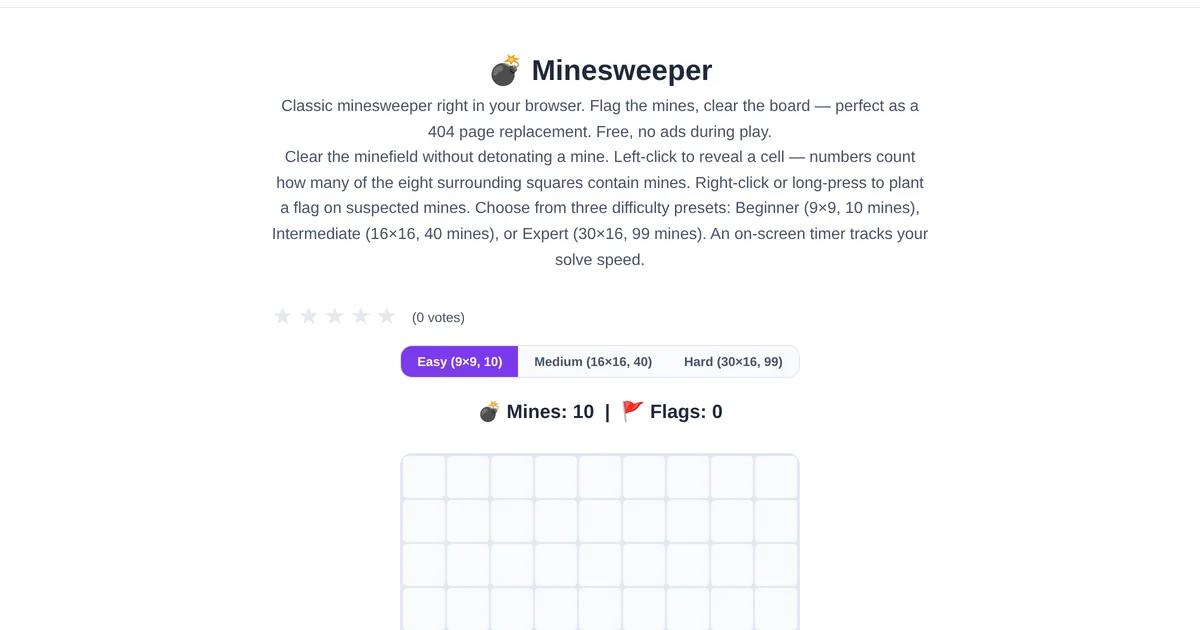
Each number reveals how many mines touch that square (including diagonals). A "1" means exactly one of the eight surrounding squares contains a mine. Your job: use overlapping numbers to deduce mine locations and flag them. The ToolStand Minesweeper offers three difficulty levels — Beginner (9x9, 10 mines), Intermediate (16x16, 40 mines), and Expert (30x16, 99 mines).
Essential patterns to learn
The 1-1 pattern. Two adjacent "1" squares touching the same unsolved area mean the mine is in the square they both touch. The remaining squares are safe. The 1-2 pattern. A "1" next to a "2" where both touch the same two unsolved squares: the mine for the "2" that is not shared with the "1" must be in the square only the "2" touches. This is the most common pattern in intermediate and expert boards. Edge logic. Numbers along the board edge have fewer adjacent squares, creating simpler constraints. Always start by solving edge numbers.
When you have to guess
Some board configurations force a 50/50 guess. Accept it and click. The goal is not to avoid guessing entirely; it is to minimize guesses through deduction. If you must guess, guess early rather than late — guessing early wastes less solved progress if you are wrong.
Brain-training benefits
Minesweeper exercises logical deduction, pattern recognition, and probabilistic reasoning — the same mental muscles used in programming, data analysis, and strategic planning. A 10-minute Minesweeper session is a better cognitive warm-up than scrolling social media.
Explore the full collection of free tools at toolstand.io. Free, forever. No sign-up. No download. Just tools that work.